


Arts Ballet Theatre of Florida: A dazzling performance rewarded with a standing ovation
Jun 15
5 min read
Updated: Jun 22
Written by Orlando Taquechel
June 14, 2026 at 9:41 AM
"This is an automatic translation performed using the Google Translate tool."

The Arts Ballet Theatre of Florida (ABTF) Spring Gala—the final program of the 2025–2026 season for the company founded and directed by Maestro Vladimir Issaev—proved to be an enjoyable performance from start to finish, thanks to the freshness of the dancers, the luminous staging, and the exceptionally high caliber of the works presented.
It is certainly no exaggeration to say that this performance marked the best season finale in the company's history.

From the warm melodies of Cuban composer Ernesto Lecuona (1895–1963)—the program opened with Alberto Méndez’s “Tarde en la Siesta,” staged by Mary Carmen Catoya—to the spectacular soundscape of Russian composer Alexander Borodin (1833–1887) and his “Polovtsian Dances” (choreographed by Issaev himself), the music heard by the audience at the Aventura Arts & Cultural Center possessed the admirable quality of driving the program forward with impressive theatrical effectiveness. It is a distinctive achievement to which the other three works completing the program also contributed:
“Danzón” (music by the Mexican Arturo Márquez and choreography by the Colombian Yanis Pikieris), a group piece created for the Ballet de Monterrey in 1973—also staged by Mary Carmen Catoya—, “Shostakovich Suites” (music by Dmitri Shostakovich and choreography by Issaev), and “La Traviata pas de deux” by Issaev, set to music by the Italian Giuseppe Verdi. Shostakovich and Issaev were born in Russia.

The diverse backgrounds of its creators did not prevent the result from being a magnificently cohesive performance of breathtaking stylistic authenticity. Having Issaev as a Ballet Master, Choreographer, and Artistic Director guarantees an integrative vision—one that has driven the company’s creative practice for years.
We are witnessing the realization of a long-gestating idea that has finally blossomed, despite the challenges imposed by surrounding realities—specifically, two circumstances ABTF shares with small ballet companies worldwide: limited company size and the transient nature of the talent.

Fortunately for everyone—artists and audiences alike—ABTF currently boasts a group of highly talented dancers from twelve countries who have expressed a desire to stay with the company. This has allowed Issaev to transform the usual annual reset (new season, new dancers) into a strategy for continuity and growth.
The success of this beautiful Gala heralds a magnificent future for ABTF, a company that, by all accounts, appears unstoppable.
Without a doubt, the dancers' engaging versatility is perhaps the best-kept secret of the Miami dance scene. They know how to project themselves in sophisticated settings (*Tarde en la siesta*), how to dance with a sense of fun (*Danzón*), and how to navigate choreography that serves as both illustration and reflection (*Shostakovich Suites*).

They also know that dancing with a near-suspended fluidity allows them to achieve an unmatched level of expressive authority. The best example is the exquisite performance by Indira Mayrani and Yoichi Habaguchi in the “La Traviata pas de deux.”
Finally, in the “Polovtsian Dances,” the entire cast embraces the call for virtuosity without faltering, and the result exceeds all expectations.
All in all, they succeeded in making the performance naturally convey a rare sense of wholeness.

“Tarde en la Siesta”—featuring four sisters as the protagonists—takes place in the courtyard of a large house on a Havana hill. Likely on Loma del Mazo, in the La Víbora neighborhood. In Cuba, hills are called lomas, and Havana is considered to have seven hills (like Rome).
Kanon Tanaka plays Esperanza, and Mayu Kanazawa plays Dulce. Soledad is portrayed by Qian Hui Tan, and Consuelo by Yayoi Sasaki. This cast brings an exotic quality to the nostalgic atmosphere that permeates Méndez’s renowned masterpiece, transforming it into a novel experience.

Of course, the conflicts faced by wealthy, privileged girls—immersed in the drowsy state characteristic of the rest-and-digest period known as the siesta—have been the same the world over since time immemorial. Here, too, once the siesta ends, the rules of conduct—rooted in established notions of right and wrong—regain their importance in the lives of the four sisters.
The danzón is Cuba’s national dance, yet it is deeply rooted in Mexico, particularly in the port city of Veracruz.
The entire company performs in Márquez and Pikieris’s Danzón. None of the dancers are Cuban—and Sebastián Cazares is the only Mexican—yet all demonstrate a true grasp of the style. Colombian dancer José Pechené stood out while performing the second pas de deux with Kanon Tanaka (who was equally brilliant in the role of Esperanza in Tarde en la siesta).

In Shostakovich Suites—a work structured in eleven sections—Issaev’s creativity abounds, and the dancers are nothing short of splendid at every moment. Yet, for some reason, the male pas de quatre performed by Sebastián Casares, Leonardo Bares, Remina Tanaka, and Ataru Matsuya, along with the adagio danced by Kansuke Nakamura and Mayu Kanazawa, linger in the memory.
In Polovetsian Dances, presented after the La Traviata pas de deux, the delightful Indira Mayrani and the outstanding Ataru Matsuya truly steal the show.
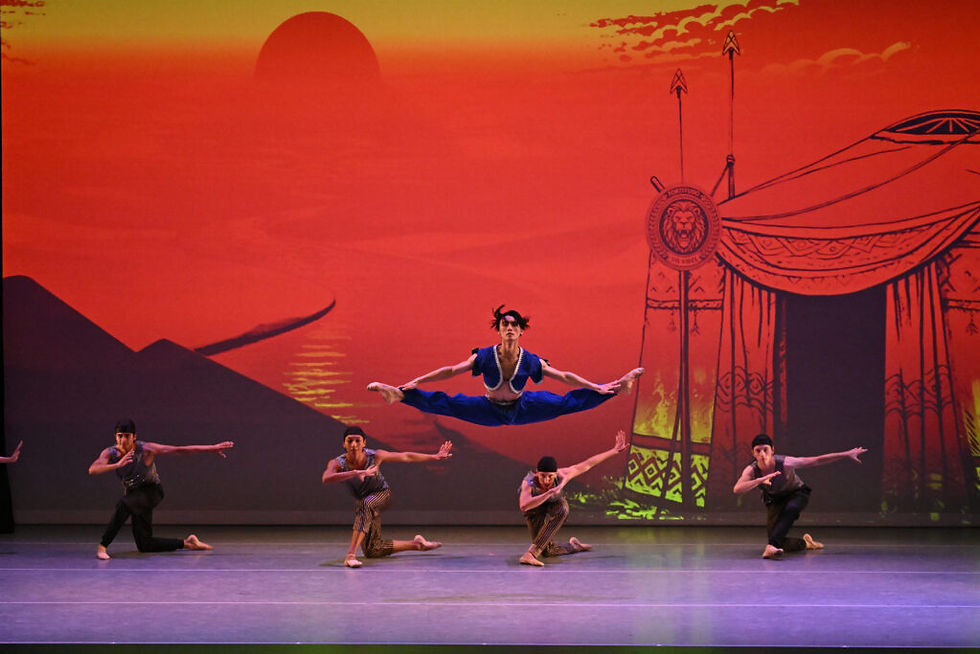
Regarding Issaev’s “Polovtsian Dances,” it is worth noting that this is a visually dazzling production offering much to admire and enjoy. It is an enriching experience for both performers and audience members alike—one that evokes deep gratitude and, fittingly, is rewarded with a standing ovation.
Suffice it to say that when the performance ends, one hesitates between leaving the theater for good or lingering nearby, hoping for a stroke of divine intervention. We wait, wishing someone would step into the lobby and shout, “Come back—they’re going to dance it again,” so we could eagerly obey, return to our seats, and relive the experience of an unforgettable night.
ArtburstMiami.com is a non-profit arts media outlet featuring fresh, original stories by writers specializing in theater, dance, visual arts, film, music, and more. Don’t miss a single story—visit www.artburstmiami.com.